


A Turkish tasbih is never only a counting tool. Pick one up in the covered bazaars of Istanbul and you feel the weight first, then the temperature of the material, then the rhythm the beads fall into between your fingers. This guide explains the materials Turkish workshops actually use, how bead count and size change the way a tasbih feels, and how to choose one that will still be in your pocket in twenty years.
1. The materials: what Turkish workshops really work with
Four families of material dominate the Turkish workshops we buy from, and each one behaves differently in the hand.
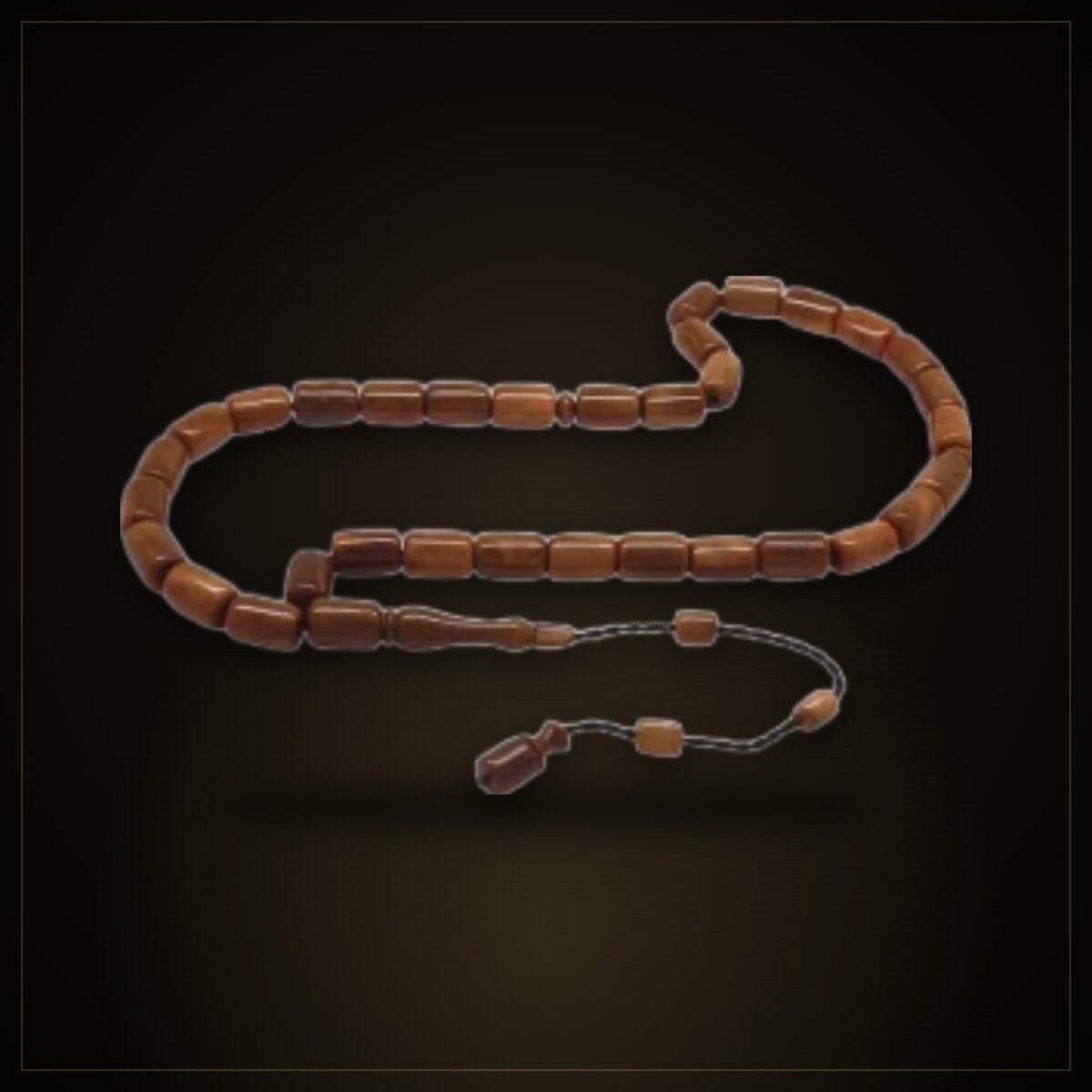
- Kuka (doum palm nut). The classic Anatolian bead. Light, warm, slightly porous, and it deepens in colour the more it is used. A henna finish gives it that red-amber glow. This is the bead most Turkish craftsmen will hand you first.
- Pressed and natural amber. Warm to the touch within seconds, almost weightless, and it carries a faint resinous scent when rubbed. Baltic amber has been traded through Anatolia for centuries — the fossilised resin in a good bead is tens of millions of years old.
- Natural stone — agate, onyx, turquoise, tiger’s eye. Cool, dense, and audible: stone beads have a distinct click that wood and amber do not.
- Olive wood and rosewood. Dense, close-grained, and almost indestructible. The most forgiving choice for daily travel.
What we do not sell is precious metal. Everything in the collection is wood, stone, amber or engraved stainless steel — which keeps the pieces honest, hard-wearing and simple to ship anywhere in the world.
2. Bead count: 33, 99 and why it matters in the hand
A 33-bead tasbih is the pocket standard: three cycles complete the traditional 99, and the loop is short enough to turn discreetly with one hand. A 99-bead strand is a different object altogether — it drapes, it is usually kept at home or in the mosque, and it suits larger beads. If you are buying your first Turkish tasbih, buy 33. If you are buying a gift for someone who already owns three, buy 99.
Bead diameter matters more than most buyers expect. Under 6 mm the strand becomes jewellery; 8–10 mm is the comfortable everyday range; above 12 mm you are holding a display piece. Browse the full tasbih collection to compare sizes side by side.
3. The details that separate a workshop piece from a souvenir
- The tassel (püskül). Hand-tied silk or cotton, tightly bound at the neck. A glued plastic tassel is the clearest sign of a machine-made strand.
- The imame. The elongated head bead should be drilled straight and finished to the same polish as the rest of the strand.
- The cord. Waxed and knotted, not nylon fishing line. A properly strung tasbih can be re-strung; a fused one cannot.
- Consistency with variation. Beads should match in size but differ slightly in grain or inclusion. Perfect uniformity means resin, not nature.
4. Caring for it
Keep wood and amber away from perfume, alcohol and hot water — all three strip the finish. Wipe stone beads with a dry cloth. Store the strand loosely coiled rather than knotted, and let kuka wood do what it is meant to do: darken, slowly, into a record of use. Full care and delivery details are in our Shipping & Delivery and Returns & Refunds policies.
5. Where the craft comes from
Bead-turning in Anatolia sits alongside the region’s older craft traditions — the marbling, calligraphy and metalwork catalogued by institutions such as the Metropolitan Museum of Art and the V&A’s Islamic Middle East collection. The workshops we buy from are small, family-run, and still finish each strand by hand, which is why our pieces are made to order rather than held in bulk.
Frequently asked questions
How many beads should a Turkish tasbih have?
Thirty-three for everyday carry, ninety-nine for home or mosque use. Turkish workshops treat 33 as the standard pocket strand.
Does kuka wood change colour over time?
Yes. Kuka darkens with skin contact and handling, which is considered a feature rather than wear. A well-used strand is noticeably deeper in tone after a year.
Can a tasbih be re-strung if the cord breaks?
If it was strung on waxed knotted cord, yes — any bead workshop can re-string it. Note that a re-strung piece counts as altered for the purposes of a change-of-mind return.
#Tasbih #PrayerBeads #TurkishCraft #KukaWood #Amber #OttomanHeritage #MadeInTurkiye #Handmade #IslamicGifts #Osmanly
\n
Read next
\n
- Reading an Anatolian Ring: Seljuk Eagle, Zulfiqar and the Fortress Wall
- Choosing a Prayer Rug and a Rahle That Last
- An Ottoman Gift Guide: Weddings, Ramadan, Eid and Everything Between
\n
Browse the full OSMANLY collection — handmade in Türkiye, shipped worldwide.
\n